In This Issue: First Section | Second Section | Third Section
This is the introduction paragraph. It will typically be a couple of sentences. Make sure “Excess Returns” is italicized. Copy and paste the introduction into the “Excerpt” section below. The “In This Issue” block above features links to anchors to create the internal links. The block has an anchor (id=”in-this-issue” to create the destination for the “Return to Top” link at the bottom of the page. Each of the sections is linked. These link can be changed to match the text. The defaults are #first, #second, and #third. To ensure the template displays correctly, select “Excess Returns” under the Categories tab for the post.
With best wishes,

Liz Hecht
Founder
Print a PDF of this newsletter
First Section
In this template post, you can see the various blocks that can appear within a post. These blocks can be moved to other areas of the post. If the block is not needed, it can be deleted. Some of these blocks have custom css associated with them. This will show up under the Block > Advanced tab.
The heading block above is set to Heading 2 style. The block contains the anchor, id=”first. If you change the text of the link in the “In This Issue” block above, you will also need to change the anchor id. You can do this be selecting “Edit as HTML” from the three dots at the right of the block (⋮).
This is a quote block. If using a quote block with more than one paragraph of text use a line of Heading size text to create the pargraph break. Note: If you use regular text, WordPress will remove the space.
This is the second paragraph of text. We use these indent blocks of text when there is no citation included.
Second Section
“This is an example of how a cited quote can appear”
―From The Title of the Publication by The Author Name
Add an empty paragraph block immediately above to create the spacing between the quote and the next paragraph.
The second section often contains the main body of the post. There can be subheads, and/or bulleted or numbered lists. Avoid indents, and use the built-in editor as much as possible. In some instances, when using a bulleted or numbered list, there will be more than one paragraph of text. Use the blocks below in those cases.
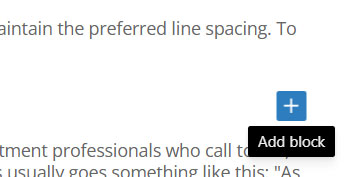
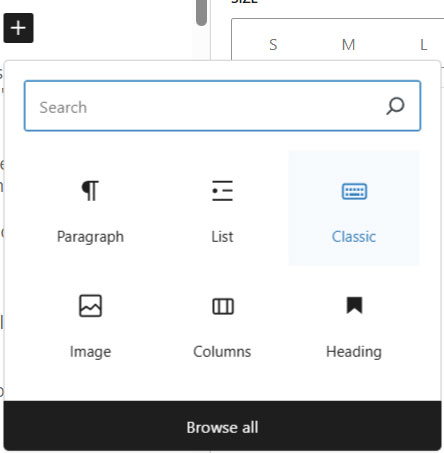
This section may contain a numbered list. Shown here below. Select the list block. You can select either a bulleted list, or a numbered list. The most recently used blocks are shown in the Add Block pop-up window. Shown here in duotone. Open the Advanced tab in the right hand margin and add “numbered-long-paragraphs ten-ways-list” in the Additional CSS Class(es) box on the side. This will help with applying the correct line spacing.
- Show up and act like you want to be there, in good times and bad. I have heard several stories about investment professionals who call to ask, “Do we really have to attend this meeting in person? Can’t we just do it by phone?” The moral of these stories usually goes something like this: “As soon as there is any shortfall in performance, that company is gone. I’m never going to bat for them.”
- Teach your clients something new. One of our firm’s key philosophical beliefs is that people want to learn something new. If you consistently provide clients opportunities to learn — about investing, the current markets and their portfolio — they are more likely to go to bat for you when you need support. And not only because you offer educational opportunities but also because they understand at a deeper level why your firm invests the way it does and why their portfolio might inevitably underperform during certain periods.
- Provide context. This is part of the educational process. Your numbers may be down on an absolute basis, but they still may be pretty darn good relative to the indices and peer group managers as well as on a risk-adjusted basis. In our practice we see investment professionals who are inordinately apologetic about underperformance without providing this context (the opposite of those who don’t even want to show up for routine client review meetings).
- Admit your mistakes. Sometimes performance is dreadful because your investment decisions were wrong. In these cases, many clients will value your firm’s ability to identify and decisively address sources of underperformance. Correcting and communicating mistakes signals both investment process integrity and human integrity. (Discussing mistakes without alarming your clients, however, requires a certain amount of finesse. The September 2011 issue of Excess Returns considers strategies for communicating mistakes effectively and the book Being Wrong, noted in this issue, explores the art and science of learning from mistakes.)
- Develop multiproduct relationships. Offering more than one product is one source of stability, but the real stability comes from cultivating multiproduct relationships. If a client leaves you for poor performance in one investment strategy, that doesn’t mean you have lost the relationship — unless that client invests in only one of your firm’s strategies. This is why many investment companies seek to build stability by offering solutions to big-picture client investment challenges — as opposed to merely selling products.
Here is an example of a bulleted list.
- Who doesn’t take a long-term investment approach (i.e., investing over a three- to five-year time horizon)?
- Who doesn’t avoid fads and trends?
- Who doesn’t avoid market timing?
- Who doesn’t practice intensive bottom-up fundamental research?
- Who doesn’t hit singles and doubles, not home runs?
When a situation arises where a different marker to a bullet is required use the CSS Class “custom-checklist” to achieve the following checklist.
- What do we mean, exactly, by this statement?
- Does this statement or number require a source?
- Can we factually substantiate this and, if not, why are we making this claim?
- Does this presentation (paper, story) capture what we really do in executing this strategy? And if not, what’s missing that would make our strategy come alive?
Third Section
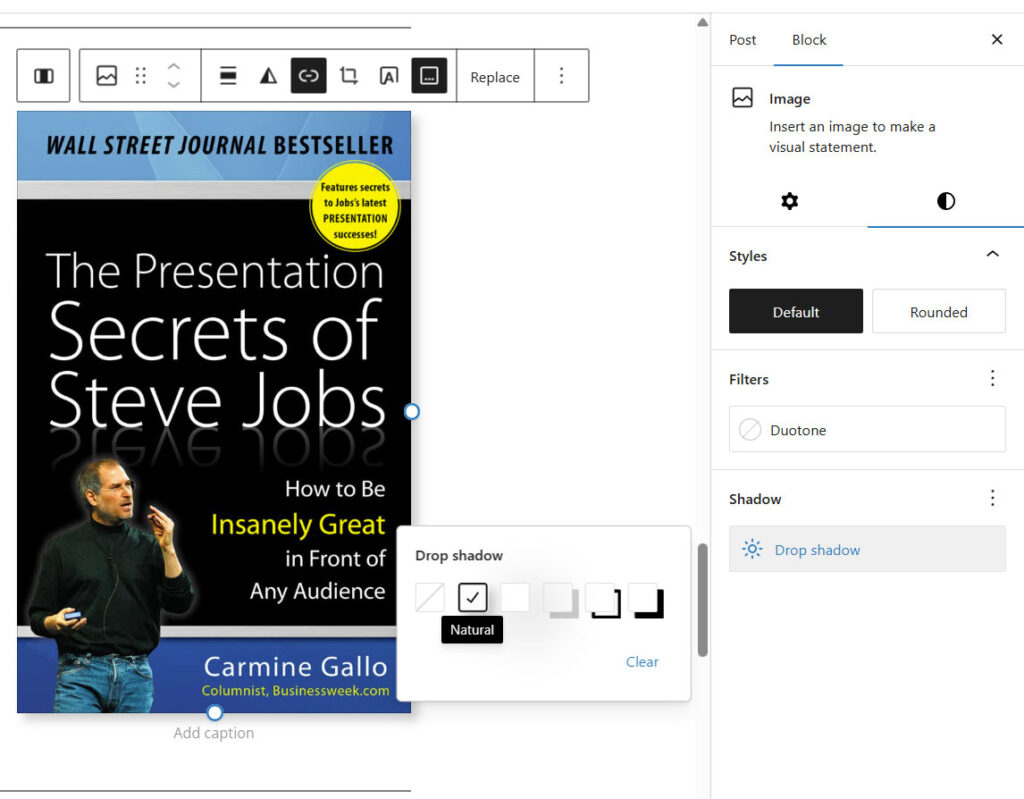
A book review is often featured in the third section. We use two columns, with the book on the right-hand side column. The screenshot on the right shows the Drop Shadow added to a book cover image.
Both the title and the book image will link to Amazon. Copy in a clean link. All links going off-site should open in a new tab.